Ansys CFX Case for New Amphibious Vehicle
Introduction
Since 1775, the United States Marine Corps hassymbolized the courage and valor of America'sfighting forces. First to arrive and often last toleave the battlefield, the Marines traditionally takeon the military's most difficult and daring assign-ments. To safeguard its troops in these brutal envi-ronments, the Corps increasingly relies onadvanced technology. As such, by the end of thedecade, the Marines will roll into combat inGeneral Dynamics Amphibious Systems'newExpeditionary Fighting Vehicle (EFV) — a hybridtank/boat designed to carry 17 combat-equippedmarines and a three-person crew over both landand sea at speeds of up to 30 miles an hour. Moreheavily armed and armored, yet faster and moremaneuverable than its predecessor, the EFVwillbe the Marines'primary combat vehicle.
To protect both its passengers and the electronicsystems in its crew compartment from overheat-ing, the EFVcontains an environmental controlsystem (ECS) that circulates and cools the cabinair. The ECS unit must keep air at a comfortabletemperature even when temperatures outside areas high as 125o Fahrenheit, while still operatingquietly enough to pose no risk to the crew's hear-ing during extended exposure without heavy earprotection. After its initial prototype failed tofully meet those high standards, GeneralDynamics put the ECS back out to bid.
The winner of the re-bid process was FairchildControls Corporation of Frederick, MD, a 40-year supplier to the aerospace industry of sophis-ticated pneumatic, hydraulic, and cooling sys-tems. The firm was tasked with improving theECS unit's airflow and minimizing operationalnoise while remaining within a strict budget.Furthermore, to meet the Marine Corps'deadlineto deliver combat-ready EFVs in 2008, FairchildControls needed to design, test, and qualify theimproved ECS in just 14 months.
Challenge
The ECS is essentially a high performance airconditioner that uses a hydraulically driven fan topull air through a refrigerant cooled evaporatorand circulate it throughout the EFVcabin. EachEFVcontains two air handling units and twocompressor units, one on each side of the crew compartment.
Because the design of the EFVitself was alreadyset, Fairchild Controls could not alter the basicsize or shape of the ECS; the redesigned compo-nents had to fit within the space and locationalready allocated to them. Additionally, for thesystem to provide the cooling capacity requiredand use low cost commercial off the shelf(COTS) components, the new fan was required toproduce an airflow rate of 1,000 cubic feet perminute with a pressure rise of 6.5 inches of waterat a speed of less than 4,500 revolutions perminute (RPM). These parameters were based on the size of the crew compartment, the heat loadfrom the electronics and crew, and the infiltrat-ed heat load from outside the vehicle on a 125oFahrenheit day. Furthermore, while meetingthese parameters, the system also needed tooperate at a noise level the human ear could tol-erate for a full day without protection.
"Typically, we purchase components from ven-dors, which essentially forces us to design oursystems around available parts, build and testprototypes for performance, and then repeat thecycle until we reach a satisfactory solution,"says Jeff Hutchison, principle engineer forFairchild Controls. "By comparison, CFX soft-ware from ANSYS enabled us to create, ana-lyze, and compare dozens of virtual designs forthe ECS in just weeks, then manufacture thecomponents ourselves. By letting us perform that work in-house, CFX tools helped stream-line the design and procurement process anddeliver a prototype that performed perfectlyafter a single round of testing.
Solution
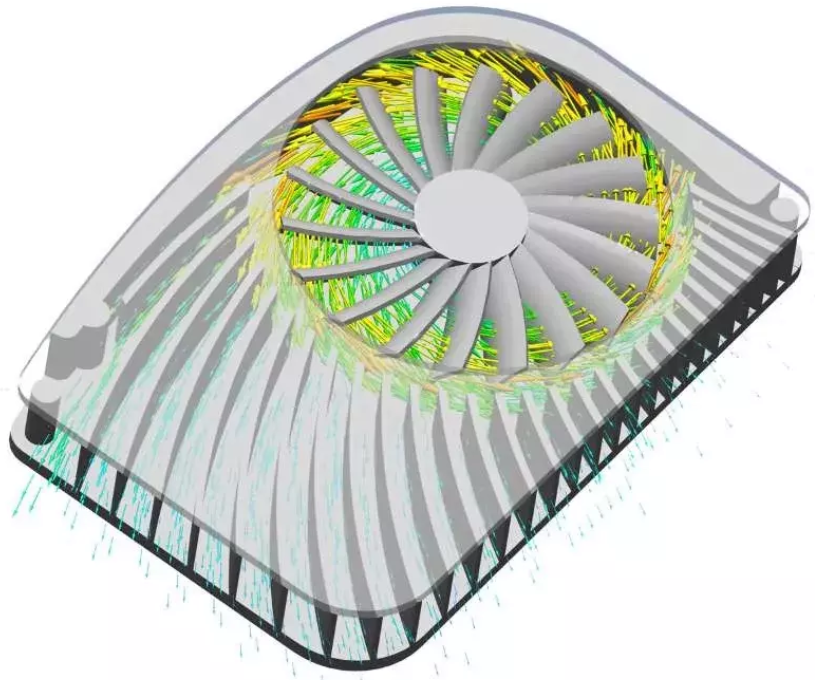
Fairchild Controls realized it could bestimprove the ECS unit's performance by replac-ing the original model's fast but loud vane axialfan with a slower, mixed flow fan with bothrotating and stationery elements. To design thefan, the company turned to CFX software fromANSYS, Inc. The industry's most powerfulsolution for modeling fluid dynamics, CFX fea-tures specialized modules that allow users torapidly design and predict the performance ofcomplex turbomachinery. Using CFX-BladeGen, CFX-TurboGrid, and CFX-TASCflow, Fairchild Controls swiftly derivedthe optimal combination of design featureswithin the necessary parameters.
The manufacturer's engineers used the suite ofCFX solutions to create and analyze 3-D mod-els of candidate fan designs in order to comparevarious combinations of blade shape, bladenumber and blade height and select a designthat met all of the performance objectives. Next,CFX-TASCflow's rotating machinery casebuilder set the fan designs in motion, allowingthe engineering team to simulate performanceand explore what-if scenarios under a widerange of simulated operating conditions.
Over the next three months, the firm then con-structed a working prototype. It imported theselected design's geometry from CFX-BladeGen directly into its CAD system as anIGES file in order to create a solid digitalmodel. Next, it coded its computer-automatedmachining tool directly from the solid, savinghours of drafting time and ensuring the dimen-sions of the computer design were duplicated ina physical prototype as precisely as possible.Finally, it assembled the working prototype andcompared its performance to the data generatedin its simulations.
"Our physical prototype performed precisely asthe CFX tools predicted it would, and we wereabsolutely confident the final product wouldalso perform as it was supposed to, even underthe demanding conditions the Marine Corpswould subject it to," Hutchison says. "With noneed to start the development cycle again foranother prototype, we were able to move swift-ly into manufacturing and testing deliverablehardware.
Benefits
CFX enabled Fairchild Controls to produce afan that created just 85 decibels of sound —well within the limits of soldiers'comfort andsafety — without compromising the environ-mental control system's ability to keep theEFV's crew compartment adequately cool.Moreover, CFX streamlined the design and testcycle significantly by allowing the design to bekept in house, allowing Fairchild Controls todeliver an affordable final product in just 14months.
The redesigned ECS unit has completed ship-ping all units required for the system design anddevelopment phase of the program and is cur-rently preparing to enter low rate initial produc-tion, facilitating the Marine Corps'plans tocomplete and deploy the EFVin 2008.
"Whether we're creating new products or meas-uring the performance of legacy products withan eye toward improvement, there's simplynothing better for measuring and analyzing airand fluid flow in turbomachinery than CFXsoftware from ANSYS," says Hutchison. "Byallowing us to move smoothly from virtualdesigns to perfectly operating prototypes, CFXhelps us reduce the development risks associat-ed with new designs."
標(biāo)簽: 點(diǎn)擊: 評論:
版權(quán)聲明:除非特別標(biāo)注,否則均為本站原創(chuàng)文章,轉(zhuǎn)載時(shí)請以鏈接形式注明文章出處。